Buying, selling or running a business?
Numbers that hold up when the money moves.
Due diligence for buyers. Exit-ready models for sellers. Operating models for CFOs. By Sergei Mochtchenkov, CFA. Fixed fee.
Buy-side due diligence
Real EBITDA, cash conversion, customer concentration and a forecast stress-test before you sign.
View serviceSellingSell-side model
Adjusted EBITDA and projections a buyer can verify, so your price holds through diligence.
View serviceRunningCFO operating model
A driver-based model that shows where margin, cash and pricing can improve.
View serviceIf a material error in my work surfaces, my fee is refunded.
Material: moves adjusted EBITDA, valuation or another key output by 5% or more, based on the records provided. Refund capped at the fee paid. Due diligence is a consulting engagement, not an audit or attest service.
Fixed-scope proposal within 24 hours. No retainers.
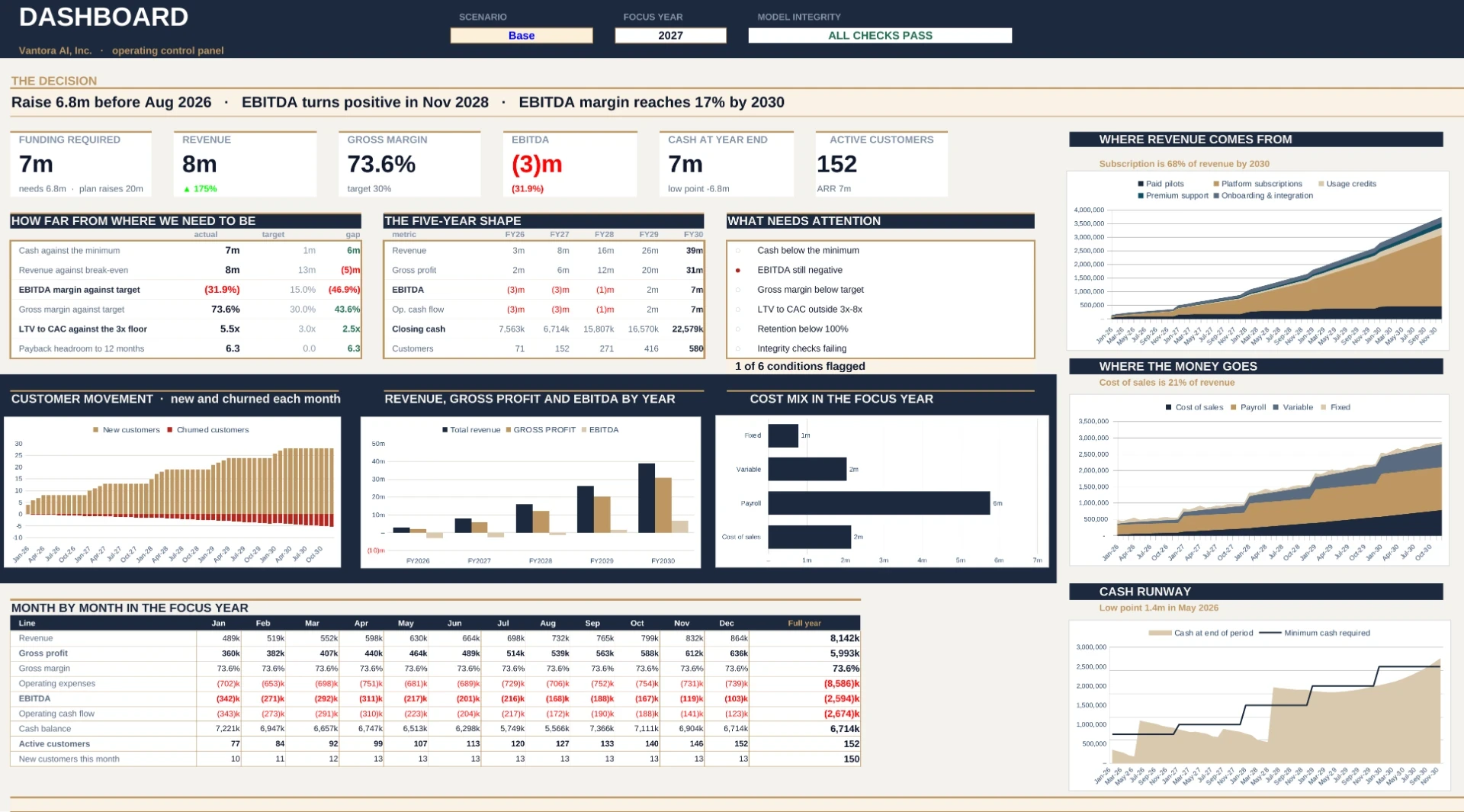
Extracts from a sample model, built for illustration. Client models are confidential and exchanged after the NDA.
- clients served
- 300+clients served
- transactions supported
- US$1B+transactions supported
- years in finance
- 20+years in finance
- models built
- 500+models built
Where engagements start
Three decisions, three models
The work changes with your side of the transaction or operating table.
You are buying on the seller's numbers
Rebuild real EBITDA, trace earnings into cash, test customer concentration and stress the forecast before you sign.
Buy-side due diligenceYour price has to survive diligence
Present adjusted EBITDA and projections a buyer can verify, with every assumption supported before questions start.
Sell-side modelYou need one operating view of the business
Connect revenue, margin, pricing, headcount and cash in a driver-based model your CFO and operating team can run.
CFO operating modelFocus
Three core engagements
Each one is fixed-scope, fixed-fee and ends with a handover you can operate without me.
- 01Buy-side due diligenceAn independent read on the target's forecast, earnings quality and cash conversion before you sign.from $6,000 · 2–3 weeks · 6 deliverablesView service
- 02Sell-side modelAdjusted EBITDA and projections a buyer can verify, so your price holds through diligence.from $4,500 · 3–4 weeks · 6 deliverablesView service
- 03CFO operating modelA driver-based operating model that shows where margin, cash and pricing can improve.from $3,500 · 2–4 weeks · 6 deliverablesView service
Also available
- Model audit from $2,500
- Valuation from $4,000
- Real estate models from $3,500
Modeling standards
Clear logic. Consistent accounting. Better decisions.
I separate modeling structure from accounting policy: FAST principles make the workbook easier to review; the applicable GAAP or IFRS framework governs the accounting assumptions.
FAST: Flexible, Appropriate, Structured, Transparent
I use FAST principles to separate inputs, calculations and outputs, keep formulas readable and make assumptions traceable. A consistent structure makes scenario changes, independent review and handover easier—not just the first presentation.
GAAP / IFRS: the accounting foundation
I align the accounting schedules with the applicable reporting framework and the business’s accounting policies, including revenue recognition, leases, depreciation, provisions and working capital. The income statement, balance sheet and cash flow are linked, with management adjustments reconciled separately from reported figures.
FAST is a modeling standard, not an accounting framework. A financial model supports analysis; it does not itself constitute audited financial statements or an assurance opinion.
For due diligence
Reconcile the forecast to historical results, test EBITDA adjustments and cash conversion, and expose unsupported growth or margin assumptions. Sensitivities show how downside cases affect valuation, financing needs and covenant headroom before a purchase decision.
For planning
Translate pricing, sales volumes, hiring and capital expenditure into an integrated cash forecast. Compare operating scenarios, size funding needs and track actuals against plan so management can act on the drivers behind a variance.
M&A synergy modeling
What is the combination actually worth?
I model the buyer and target on a standalone basis before adding synergies. The acquisition case must explain the market niche being purchased—and what the combined business gains or loses.
- 01
Competitive analysis & market niche
Map the target’s customer segments, competitors, substitutes, pricing and routes to market. Test whether the acquisition adds a differentiated position, access to a new niche or simply more exposure to the buyer’s existing market.
- 02
Revenue synergies & cannibalization
Estimate cross-selling and distribution gains by customer and product, then deduct overlapping sales, product substitution, pricing pressure and customer attrition. Moving revenue from one group company to another is not incremental growth.
- 03
Cost savings & integration investment
Build savings from procurement, shared functions and capacity consolidation, with explicit timing and implementation assumptions. Include severance, systems migration, capex and working capital needs rather than treating savings as immediate or cost-free.
- 04
Net cash flow & deal returns
Bridge standalone value to combined value using net synergy cash flows after tax and integration costs. Stress-test delivery, delays and cannibalization to show the effect on purchase-price headroom, leverage and investment returns without double-counting benefits.
The output is a standalone-to-combined value bridge, a timed synergy schedule and a downside case—not a blanket percentage uplift to the seller’s forecast.
How it works
Four steps, no surprises
From first call to handover, you always know the scope, the number and the date.
- 01
Send the brief
The contact form takes the situation: what exists, what it needs to do, and who has to be convinced. No pitch deck.
- 02
Fixed-scope proposal in 24h
Written scope, deliverables, timeline and a fixed fee. You know the number before anything starts.
- 03
Build or audit, weekly check-ins
Working sessions each week against a visible milestone list. No four-week silence followed by a surprise.
- 04
Handover and 30 days support
A recorded walkthrough of every tab and driver, plus thirty days of questions answered at no extra cost.
Case studies
What changed, in numbers
Series A model: 11 errors fixed, round closed at $14M
- material errors found
- 11
- material errors found
- audit turnaround
- 5 days
- audit turnaround
- round closed
- $14M
- round closed
Mixed-use development: equity waterfall rebuilt, IC approval in one pass
- levered IRR, base case
- 17.8%
- levered IRR, base case
- through investment committee
- 1 pass
- through investment committee
- peak equity sized
- $22M
- peak equity sized
Hardware scale-up: working capital peak found before it hit
- working capital gap identified
- $3.2M
- working capital gap identified
- cash conversion cycle
- 7 months
- cash conversion cycle
- to a financed plan
- 6 weeks
- to a financed plan
Free tools
Three calculators, no sign-up
Runs in your browser. Nothing stored.
DCF calculator
Revenue, margin, capex, WACC and terminal growth into an enterprise value range with a full sensitivity table.
Runs in your browser. Nothing stored.
Open the tool →Runway calculator
Cash, burn and revenue growth into months of runway, with the month-by-month cash curve.
Runs in your browser. Nothing stored.
Open the tool →Model health check
Twelve questions, a score out of 100, and the three risks most likely to surface in diligence.
Runs in your browser. Nothing stored.
Open the tool →Clients
In their words
"It’s been a pleasure working with him. He spend time to take deep understanding of our business and translates that into well-structured financial models."
"Great work, very explanatory, amazing communication highly recommend"
"Sergei is absolutely phenomenal to work with. A true professional, he has significantly helped my company and provided invaluable support on multiple important business calls."
"Sergei is honest, hardworking and knows what he's doing."
"Sergei is excellent in everything he does and a true pleasure to work with."
"Sergei worked well with us and was committed and patient to complete his work to a high standard. He communicated well, and was able to do a number of reviews and adjustments…"
Pricing
Fixed fees, published
Market-average starting points. Your proposal carries the exact number before work begins.
Model audit
$2,500
fixed scope
Independent review of an existing model before you put it in a data room.
- Cell-level formula review
- Ranked error register
- Assumption benchmark check
- Audit summary letter
Valuation
$4,000
fixed scope
DCF, comparables and precedent transactions with a written memo.
Valuation fees are fixed in advance and never depend on the value conclusion.
- WACC build and DCF
- Comp sets and football field
- Sensitivity grid
- 10–15 page memo
Model build
$3,500
from
A three-statement or development model built from your data.
- Driver-based revenue build
- Full three-statement linkage
- Scenario manager
- Handover walkthrough
Fundraise package
$7,500
from
Model, cap table, returns view and diligence prep for a live round.
- Fundraising model
- Cap table and dilution
- Investor MOIC and IRR
- Diligence Q&A prep
FAQ
Questions people ask before booking
Two ways to start
Get a quote, or start with the checklist.
If you know what you need, request a quote — a fixed-scope proposal follows within 24 hours. If you are still deciding, take the checklist investors effectively run your model against and see where it stands.
Get a quote
Send the brief — what exists, what it needs to do, and who has to be convinced. A fixed-scope proposal with the exact fee follows within 24 hours.